fish · Cyprinidae
Tinfoil barb
Barbonymus schwanenfeldii
Wild range: Mekong and Chao Phraya basins (Thailand, Laos, Cambodia, Vietnam), the Malay Peninsula, Sumatra and Borneo (Seriously Fish; FishBase). Native Singapore populations may be gone, but introduced feral fish now occur there (Seriously Fish). (Asia)

At a glance: Tinfoil barb care
Compiled reference information. Review the care notes and original sources below.
What temperature is listed for Tinfoil barb?
The compiled profile lists 22.0–26.0 °C for Tinfoil barb (Barbonymus schwanenfeldii). Check the original sources below for context and differing recommendations.
What tank size is listed for Tinfoil barb?
The profile lists a minimum tank volume of 200.0 US gallons (757.0 liters). Volume alone does not establish suitability; consider dimensions, group size and other inhabitants alongside the full care notes.
What pH is listed for Tinfoil barb?
The compiled profile lists a pH of 6.0–7.5. Review the cited care sources alongside the other water parameters in this profile.
Natural habitat
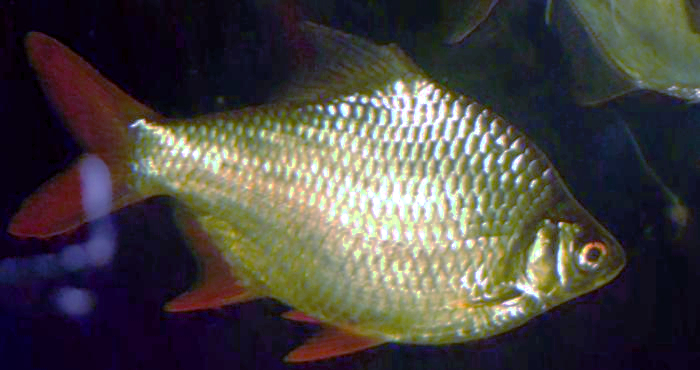
The tinfoil barb is a large, fast-swimming Southeast Asian cyprinid: bright silver with red fins, a black tip on the dorsal fin and a black stripe along each tail lobe. It is sold at 5–7 cm but grows to about 25–35 cm, so a group needs a very large, long, well-filtered tank. It is peaceful but very active, eats small fish and soft plants, and is assessed Least Concern.
Where they are found
Primary name follows ITIS and the trade: Barbonymus schwanenfeldii (Bleeker, 1853), valid in ITIS. Eschmeyer's Catalog of Fishes, FishBase and Seriously Fish now use the corrected spelling Barbonymus schwanefeldii (Bleeker, 1854): Bleeker misspelled the collector H. W. Schwanefeld's name, and Kottelat (2013) ruled the original spelling must stand. Both spellings and the older combinations Barbus schwanenfeldii (original), Barbodes schwanenfeldii, Puntius schwanenfeldii and Systomus schwanefeldi are aliased here. The congener Barbonymus altus (red-tailed or gold tinfoil barb) is also sold as 'tinfoil barb'; adult B. schwanenfeldii is told apart by the black stripe along each tail lobe, which B. altus lacks, and by its more silvery body (Seriously Fish). B. altus is not aliased. Golden, albino and 'blushing' trade forms are the same species, and the species has also been artificially dyed. Size: FishBase and Seriously Fish give a wild maximum of 35 cm SL; aquarium adults are usually 25–33 cm (Tropical Fish & Aquariums; NAFB). IUCN: Least Concern (Lumbantobing & Allen 2020, as B. schwanefeldii).
Aquarium care
Plan for the adult size, not the 5–7 cm shop fish: a group of six or more needs a very long tank of about 750–800 L / 200 gal (Seriously Fish 210 × 60 cm, ~756 L; Aqua-Pedia 800 L; Fish Laboratory 176+ gal for an adult school; Tropical Fish & Aquariums 180 gal long term). Aqueon and Tropical Fish & Aquariums give 125 gal as an absolute floor for adults, and smaller figures (70–80 gal) seen on some care sheets are too small. Keep it at 22–26°C, pH 6.0–7.5, 5–15 dGH and 3–8 dKH (Aqua-Pedia; NAFB; Fish Laboratory; Tropical Fish & Aquariums); farm-bred fish tolerate wider ranges (Seriously Fish 20–28°C, pH 6–8). Give it strong filtration, good oxygenation and current, open swimming space, only hardy or artificial plants, and a heavy, tight lid because it is skittish and jumps powerfully (Seriously Fish; Fish Laboratory). Large weekly water changes are needed because a group of big fish produces a lot of waste.
Feeding
Mainly herbivorous in the wild, eating aquatic and flooded land plants and filamentous algae, plus insects, worms, crustaceans and small fish (FishBase; Seriously Fish). In the aquarium it eats almost anything: feed good pellets or flakes with plenty of vegetable matter (shelled peas, blanched courgette, spinach, algae wafers) and some live or frozen foods. It will eat soft aquarium plants. Avoid overfeeding (Seriously Fish; Tropical Fish & Aquariums).
Compatibility
Peaceful toward fish its own size but will eat small fish, and its constant activity and greedy feeding upset slow or timid tankmates (Seriously Fish). Keep it only with large, robust fish such as larger cichlids, catfish, characins and other big cyprinids (Seriously Fish; Wikipedia). Keep at least six; too few can make individuals skittish or aggressive (Seriously Fish).
Breeding
An egg-scatterer with no parental care; a female can release thousands of eggs at once (Seriously Fish; FishBase). It is not known to have been bred in home aquaria because of its size; trade fish are farmed in Southeast Asia and elsewhere, often with hormone-induced spawning (Seriously Fish; CTSA). Mature females are usually deeper-bodied than males.
Sources
Compiled from multiple independent care sheets — not copied from a single site.