fish · Cichlidae
Surinam eartheater
Geophagus surinamensis
Wild range: Saramacca and Suriname rivers in Suriname, and the Marowijne (Maroni) River on the Suriname and French Guiana border (FishBase). (South America)

At a glance: Surinam eartheater care
Compiled reference information. Review the care notes and original sources below.
What temperature is listed for Surinam eartheater?
The compiled profile lists 22.0–25.0 °C for Surinam eartheater (Geophagus surinamensis). Check the original sources below for context and differing recommendations.
What tank size is listed for Surinam eartheater?
The profile lists a minimum tank volume of 79.0 US gallons (300.0 liters). Volume alone does not establish suitability; consider dimensions, group size and other inhabitants alongside the full care notes.
What pH is listed for Surinam eartheater?
The compiled profile lists a pH of 6.0–7.5. Review the cited care sources alongside the other water parameters in this profile.
Natural habitat
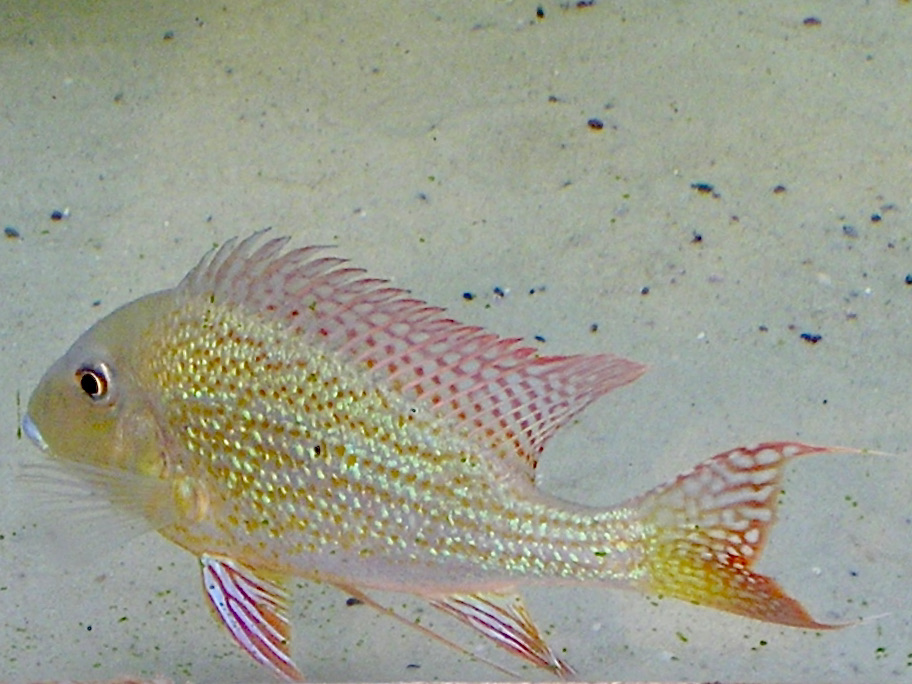
A large, peaceful South American eartheater that sifts mouthfuls of sand for food. Adults reach roughly 25-30 cm long in total length and show rows of red and blue-green iridescent spots on a silvery body. True fish from Suriname are rarely imported, and most eartheaters sold under this name are other members of the G. surinamensis group, so check the collection locality if you want the real species. It needs a long tank, a deep bed of soft sand and very clean water.
Where they are found
Geophagus surinamensis (Bloch, 1791) is valid in ITIS (TSN 169919), GBIF (5208434, accepted), FishBase and Catalog of Fishes; the original name was Sparus surinamensis, and Sparus trimaculatus is a synonym (AquaInfo). Redescribed by Kullander & Nijssen (1989, The cichlids of Surinam) (FishBase). FishBase's English common name is Redstriped eartheater. Native to the Saramacca, Suriname and Marowijne rivers in Suriname and French Guiana (FishBase); AquaInfo also lists Guyana, which FishBase does not. Max size 17.2 cm SL (FishBase), about 30 cm TL (FishBase, citing Ref. 5723; AquaInfo 25-30 cm). Trade note: 'surinamensis' has long been a catch-all label in the hobby, and most fish sold under it belong to related G. surinamensis-group species such as G. brachybranchus, G. altifrons, G. abalios or undescribed forms (Aquarium Glaser; Aquarist Atlas). The true species has no dark markings on the head. This row describes true G. surinamensis; lookalikes are noted here, not aliased. IUCN: Least Concern (assessed 2023, via FishBase).
Aquarium care
Keep a group in a long tank of at least 150 cm, about 300 L (AquaInfo gives 150 cm; Aquatic-Art gives 300 L); a larger tank is better for adults. Keep it at about 22-25°C (FishBase; AquaInfo), pH 6.0-7.5 and soft to moderately hard water; hosts give FishBase pH 6.0-8.0 and 5-19 dH, AquaInfo pH 7.0-7.5 and 8-12 GH, and Aqua-Fish.net pH 6-8 and 4-18 dH. The one essential furnishing is a deep bed of fine, smooth sand, because it feeds by sifting the substrate and sharp gravel can injure its mouth and gills. Add driftwood, rounded stones and hardy plants anchored in pots. It produces a lot of waste and is sensitive to dissolved organics, so filter strongly and change water often (AquaInfo; Aqua-Fish.net).
Feeding
An omnivore that leans towards plant matter and feeds by digging into the sand with its protrusible mouth (FishBase). Feed sinking pellets or tablets, frozen or live foods such as mosquito larvae, daphnia, Artemia and shrimp, and vegetable foods such as Spirulina, blanched lettuce or cucumber. Make sure food reaches the bottom (AquaInfo).
Compatibility
Peaceful and not very territorial for a cichlid, sometimes even shy; it becomes somewhat aggressive only when breeding (AquaInfo). Keep it with its own kind and other calm, similar-sized South American fish such as other peaceful eartheaters, severums and larger characins. Avoid fish small enough to be swallowed, aggressive cichlids and fin-nippers.
Breeding
Considered fairly easy to breed. About 200-250 eggs are laid on a flat stone or in a pit and fertilised, then both parents take them into their mouths. The fry are released after about 3 days and are guarded by both parents, who take them back into their mouths if danger threatens. Raise the fry on Artemia nauplii (AquaInfo; FishBase).
Sources
Compiled from multiple independent care sheets — not copied from a single site.