Catalog / invertebrates / Riceland prawn
invertebrate · Palaeomonidae
Riceland prawn
Macrobrachium lanchesteri
Wild range: Southeast Asia (Asia)
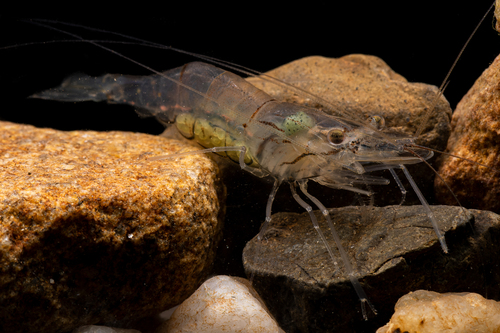
At a glance: Riceland prawn care
Compiled reference information. Review the care notes and original sources below.
What temperature is listed for Riceland prawn?
The compiled profile lists 22.0–36.0 °C for Riceland prawn (Macrobrachium lanchesteri). Check the original sources below for context and differing recommendations.
What tank size is listed for Riceland prawn?
The profile lists a minimum tank volume of 10.0 US gallons (38.0 liters). Volume alone does not establish suitability; consider dimensions, group size and other inhabitants alongside the full care notes.
What pH is listed for Riceland prawn?
The compiled profile lists a pH of 6.4–8.3. Review the cited care sources alongside the other water parameters in this profile.
Natural habitat
Lanchester's freshwater prawns thrive in stagnant and slowly flowing freshwater habitats. They are found in rivers and rice plantations, often in shallow areas basking in sunlight. Their environments may vary but they require specific water conditions to thrive.
Where they are found
Indigenous to regions such as Australia and Southeast Asia, Macrobrachium hendersoni thrives in neutral to alkaline water and can be found in various freshwater habitats.
Aquarium care
Ensure a well-cycled tank before introducing Whisker shrimp, as they are sensitive to ammonia and nitrates. Provide ample hiding spaces and avoid overstocking to minimize aggression. Regular water changes and monitoring water parameters are crucial for their health.
Feeding
Lanchester's freshwater prawns have a varied diet that includes protein-rich foods like fish fry and snails, along with detritus and algae. They are territorial during feeding, often monopolizing food resources.
Compatibility
Due to their aggressive nature, Whisker shrimp should ideally be housed alone or in small groups of one male to multiple females. Avoid keeping them with small fish or invertebrates, as they may prey on them.
Breeding
Breeding can be achieved in freshwater, making it easier for hobbyists. Females will carry fertilized eggs until they hatch, and offspring can thrive in the same water conditions as the adults.
Sources
Compiled from multiple independent care sheets — not copied from a single site.