fish · Tetraodontidae
Pea puffer
Carinotetraodon travancoricus
Wild range: Southwestern India (Asia)
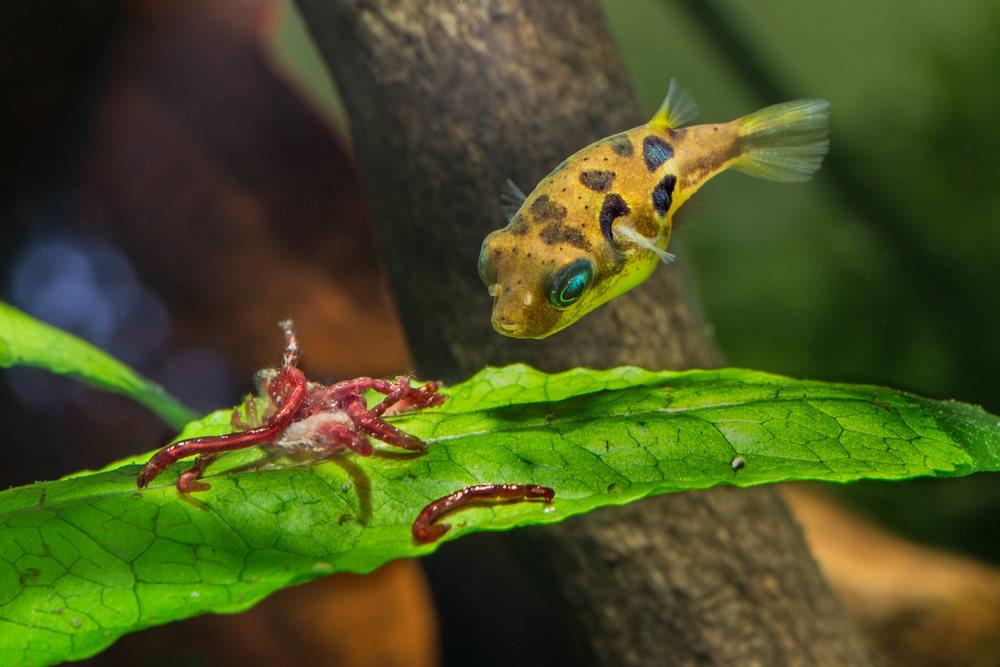
At a glance: Pea puffer care
Compiled reference information. Review the care notes and original sources below.
What temperature is listed for Pea puffer?
The compiled profile lists 22.2–28.0 °C for Pea puffer (Carinotetraodon travancoricus). Check the original sources below for context and differing recommendations.
What tank size is listed for Pea puffer?
The profile lists a minimum tank volume of 5.0 US gallons (19.0 liters). Volume alone does not establish suitability; consider dimensions, group size and other inhabitants alongside the full care notes.
What pH is listed for Pea puffer?
The compiled profile lists a pH of 6.8–8.3. Review the cited care sources alongside the other water parameters in this profile.
Natural habitat
Pea puffers inhabit the lush freshwater environments of Kerala, where they thrive in slow-moving, heavily vegetated waters with abundant leaf litter and overhanging banks. These habitats provide natural cover and food sources essential for their well-being.
Where they are found
Historically, the pea puffer was first discovered in the Pamba River in the kingdom of Travancore. Its natural distribution now includes various freshwater habitats, which are under threat from habitat destruction and the aquarium trade.
Aquarium care
It is essential to maintain excellent water quality for pea puffers as they are very intolerant of poor conditions. Regular water changes and proper filtration are necessary to keep nitrate levels low, ideally below 15 ppm, and ammonia and nitrite levels at 0 ppm.
Feeding
Pea puffers thrive on a varied diet that mimics their natural feeding habits. Prioritize live or frozen foods such as daphnia, glassworms, and small snails, which stimulate their hunting instincts. Avoid feeding them high-fat, flake, or pellet food as they may not accept these. Offer smaller, frequent meals to maintain health and promote activity.
Compatibility
Pea puffers can be aggressive, particularly towards other members of their species. It is advised that they are kept in species-only tanks or with small, fast-swimming fish to avoid fin nipping.
Breeding
Breeding occurs in groups where males compete for females, which choose breeding sites in vegetation like Java moss. After spawning, parents should be separated from the eggs once fertilization occurs to prevent them from consuming the fry, which hatch in about five days.
Sources
Compiled from multiple independent care sheets — not copied from a single site.