fish · Cichlidae
Nicaragua cichlid
Hypsophrys nicaraguensis
Wild range: Central America, Atlantic slope: San Juan drainage including Lake Nicaragua (Nicaragua and Costa Rica), south-east to the Matina River drainage in Costa Rica. IUCN (Lyons & Angulo 2020) also maps a disjunct northern population in the Coco River on the Honduras–Nicaragua border. Possibly introduced in Hawaii and the Philippines (Fishkeeper; Seriously Fish; FishBase; IUCN via Wikipedia; USFWS ERSS). (Central America)

At a glance: Nicaragua cichlid care
Compiled reference information. Review the care notes and original sources below.
What temperature is listed for Nicaragua cichlid?
The compiled profile lists 23.0–28.0 °C for Nicaragua cichlid (Hypsophrys nicaraguensis). Check the original sources below for context and differing recommendations.
What tank size is listed for Nicaragua cichlid?
The profile lists a minimum tank volume of 64.2 US gallons (243.0 liters). Volume alone does not establish suitability; consider dimensions, group size and other inhabitants alongside the full care notes.
What pH is listed for Nicaragua cichlid?
The compiled profile lists a pH of 7.0–8.0. Review the cited care sources alongside the other water parameters in this profile.
Natural habitat
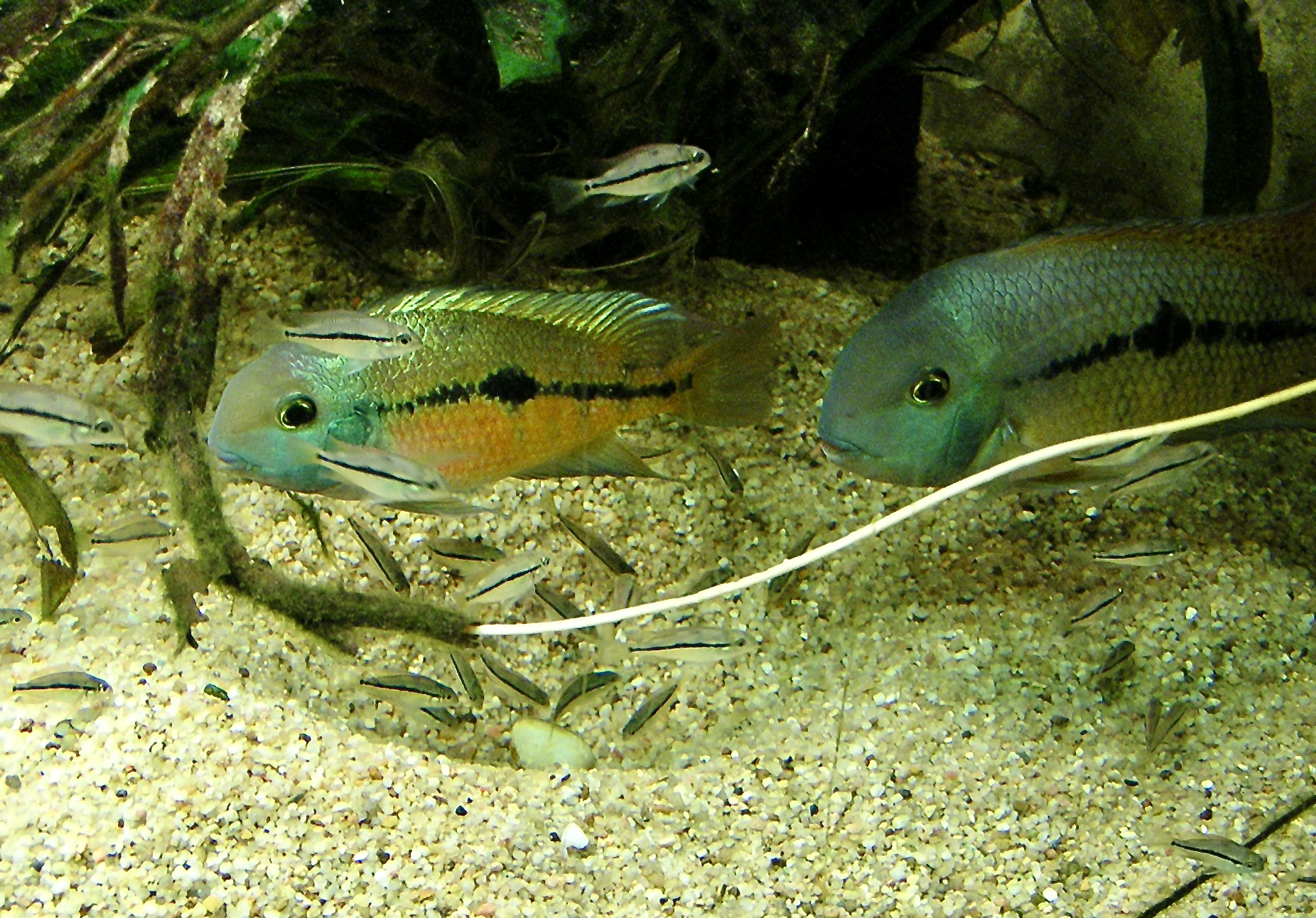
A colourful, deep-bodied Central American cichlid with a strongly rounded head and a small, low-set mouth. Adults show a gold to coppery or orange-red body, an iridescent blue-green head and a dark mid-lateral stripe with a central flank blotch. Unusually for a cichlid, females are often the more colourful sex and keep the full black stripe, while males grow larger, develop a small nuchal hump, and their stripe fades to a single spot. One of the calmer large Central Americans: territorial, but best kept as a bonded pair in a large, hard-water tank.
Where they are found
Catalog primary Hypsophrys nicaraguensis (Günther, 1864): ITIS lists it as valid; GBIF accepts it, with the Catalog of Fishes (2004) checklist giving the (Günther, 1864) authorship; FishBase uses it (as cited by USFWS ERSS 2019); and it is the trade name used by Seriously Fish, Fishkeeper and Practical Fishkeeping. The authorship is in parentheses because the species was described as Heros nicaraguensis Günther, 1864 (type locality Lake Nicaragua). Newer name: Chakrabarty & Sparks (2007, Zootaxa; reported by Practical Fishkeeping) and the current Catalog of Fishes (via Wikipedia, 2025) treat Hypsophrys unimaculatus Agassiz, 1859 as the senior synonym and valid name. This is the same species, only a nomenclatural change, so under the naming rule the established trade/ITIS name stays primary and H. unimaculatus goes in the aliases. Other synonyms and former combinations: Cichlasoma nicaraguense, Copora nicaraguensis, Herichthys nicaraguensis, Heros balteatus Gill, 1877, Cichlasoma balteatum, and Cichlasoma spilotum Meek, 1912 (the source of the trade name 'Spilotum'; Chakrabarty & Sparks suggested C. spilotum might be a valid species, but it is currently listed as a synonym). Neetroplus nematopus was briefly moved into Hypsophrys (2007–2016) but is now back in Neetroplus. Several locality colour forms exist, and it has been hybridised with the convict cichlid. 'Parrot cichlid' and 'Butterfly cichlid' are also used for this fish, but they are not aliased here because they clash with other catalog rows (true-parrot-cichlid, the blood parrot hybrid, and butterfly/ram cichlids).
Aquarium care
A large but comparatively mild Central American cichlid. Plan at least 243 L / 64 US gal (about 120 × 45 × 45 cm, a 4 ft footprint) for an adult pair (Seriously Fish; Aquariadise and Aquarium-Pro agree; Fishkeeper and Practical Fishkeeping both say 120 cm / 4 ft). Mixing it with other cichlids needs much more space, about a 6 ft tank (Seriously Fish). Keep it in neutral to alkaline, moderately hard water at 23–28°C, pH 7.0–8.0 and 8–20 dGH; it does poorly in acidic water. Use a soft sand or fine-gravel substrate, because it digs, especially when breeding. Build caves and visual barriers from rock, bogwood and flowerpots, set directly on the tank floor, and stick to attached plants such as Anubias and Java fern. Filtration must be efficient but without strong current. The species is sensitive to nitrogenous waste, so small, frequent water changes are important (Fishkeeper; Seriously Fish; TankBud; Aquariadise).
Feeding
Omnivore. In the wild adults eat bottom detritus, seeds, leaves and snails, and juveniles eat aquatic insects (FishBase via USFWS ERSS). In the aquarium, feed quality cichlid pellets or sticks and flake (both carnivore and spirulina/herbivore formulas), plus frozen bloodworm, Mysis, brine shrimp and chopped prawn, with occasional earthworms. Include greens such as blanched spinach or courgette (zucchini) or spirulina foods. It will eat snails (Seriously Fish; Fishkeeper; AquaticCommunity; Aquariadise).
Compatibility
Relatively peaceful for a large Central American cichlid, but still territorial, especially when breeding. It is not community-safe, and it will eat any fish small enough to swallow (TankBud; Fishkeeper). It is best kept as a bonded pair. Suitable tankmates in a large tank are robust, similar-sized fish: large barbs and characins (e.g. silver dollars as dithers), armoured catfish and loricariids, and moderate Central/South American cichlids, given about a 6 ft tank. Avoid small fish and very aggressive species such as red devils or Texas cichlids (Seriously Fish; Fishkeeper; AquaticCommunity).
Breeding
Pairs are best formed by growing on 6 or more juveniles and letting them pair naturally. Once a pair forms, remove the others, because pairs usually stay together for life (Seriously Fish). Offer a good-sized cave or let the pair excavate one. Spawning often happens under cover of darkness. The non-adhesive eggs (up to about 400) roll loose, and the parents gather them back to the nest. They hatch in about 2–4 days, and fry swim free a few days later. Feed Artemia nauplii, then crushed or powdered dry food. A shoal of dither fish such as silver dollars can ease pair aggression. Don't separate the fry too early, or the male may push to re-spawn and turn on the female (Seriously Fish; Fishkeeper).
Sources
Compiled from multiple independent care sheets — not copied from a single site.