Catalog / fish / Kissing gourami
fish · Osphronemidae
Kissing gourami
Helostoma temminckii
Wild range: Southeast Asia (Asia)
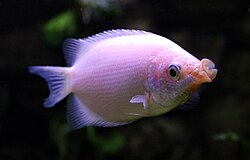
At a glance: Kissing gourami care
Compiled reference information. Review the care notes and original sources below.
What temperature is listed for Kissing gourami?
The compiled profile lists 22.0–28.0 °C for Kissing gourami (Helostoma temminckii). Check the original sources below for context and differing recommendations.
What tank size is listed for Kissing gourami?
The profile lists a minimum tank volume of 53.0 US gallons (200.0 liters). Volume alone does not establish suitability; consider dimensions, group size and other inhabitants alongside the full care notes.
What pH is listed for Kissing gourami?
The compiled profile lists a pH of 6.0–8.6. Review the cited care sources alongside the other water parameters in this profile.
Natural habitat
Kissing Gouramis inhabit slow-moving waters in Southeast Asia, including rivers, lakes, ponds, and areas with abundant vegetation. They thrive in warm, turbid waters rich in organic matter and can adapt to varying hardness levels.
Where they are found
The natural range of the Zebra Cichlid is primarily concentrated around the eastern shoreline of Lake Malawi, where it inhabits depths of about 1 to 20 meters. This area is characterized by a mix of rocky substrate and sandy bottoms, providing a complex ecosystem for this fish species.
Aquarium care
They are relatively hardy and easy to care for. It's essential to provide them with a spacious aquarium that has clear access to the surface, as they are surface breathers.
Feeding
Kissing Gouramis have a strong herbivorous tendency and should be fed a varied diet including spirulina-based foods, algae wafers, and blanched vegetables. They require frequent feeding (1-2 times daily) and should have access to tank surfaces with algae for natural foraging.
Compatibility
They are generally peaceful and do well in community tanks, especially when kept in groups of three or more, with an ideal ratio of two females for every male.
Breeding
Breeding Pseudotropheus zebra is relatively straightforward. They are mouthbrooders, with females laying eggs on flat surfaces and then taking them into their mouths for incubation. Provide a separate breeding tank with a suitable substrate and hiding places to encourage breeding behavior.
Sources
Compiled from multiple independent care sheets — not copied from a single site.