fish · Cichlidae
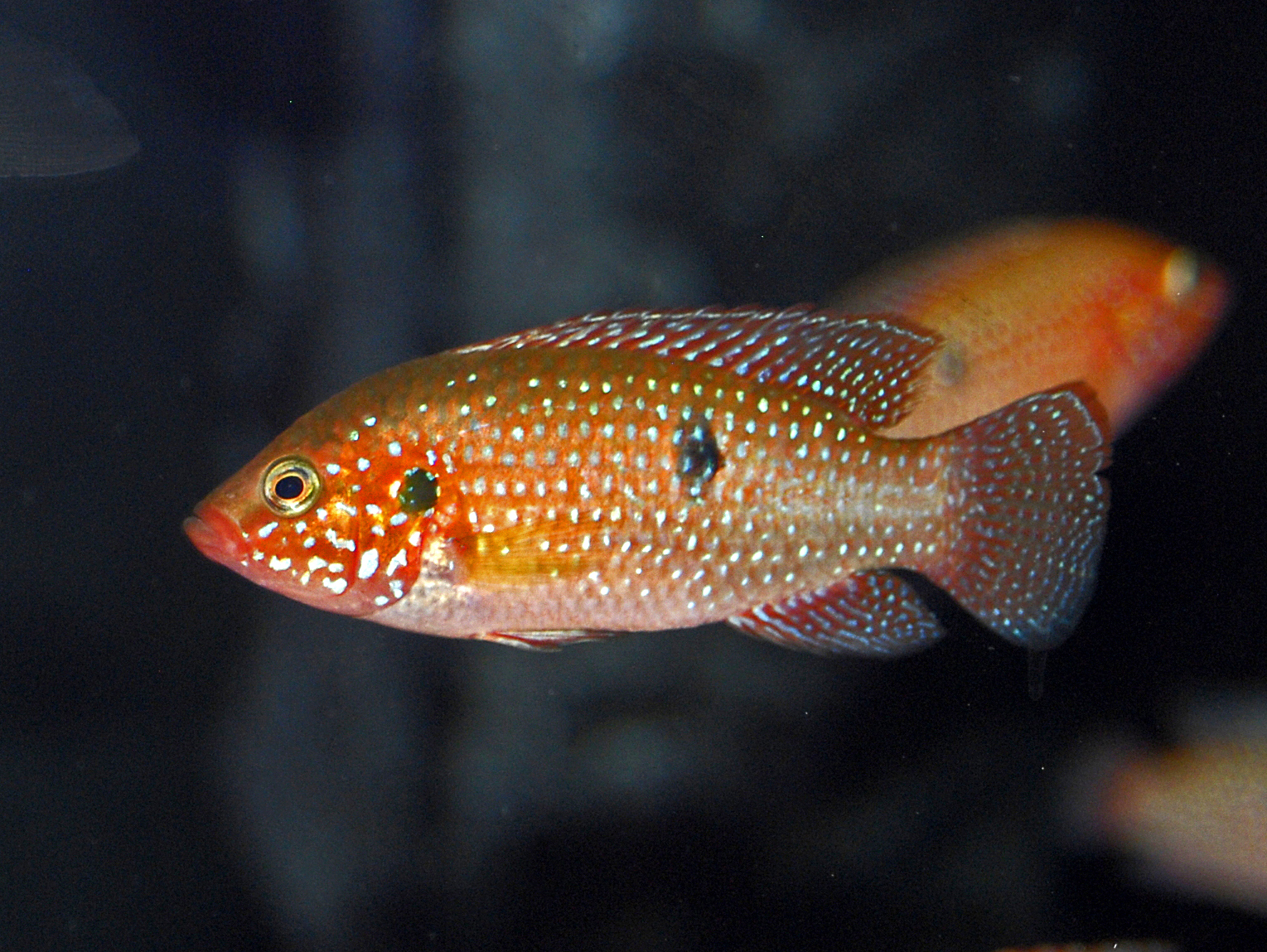
Jewel cichlid
Hemichromis lifalili
Wild range: Lower and central Congo River basin (DRC / Republic of the Congo / Central African Republic), including Lake Tumba; absent from Shaba (Katanga), Kasai, rapids, and swampy habitats (Africa)

At a glance: Jewel cichlid care
Compiled reference information. Review the care notes and original sources below.
What temperature is listed for Jewel cichlid?
The compiled profile lists 22.0–26.0 °C for Jewel cichlid (Hemichromis lifalili). Check the original sources below for context and differing recommendations.
What tank size is listed for Jewel cichlid?
The profile lists a minimum tank volume of 30.0 US gallons (114.0 liters). Volume alone does not establish suitability; consider dimensions, group size and other inhabitants alongside the full care notes.
What pH is listed for Jewel cichlid?
The compiled profile lists a pH of 6.5–7.5. Review the cited care sources alongside the other water parameters in this profile.
Natural habitat
Still and slow-moving, well-oxygenated forest creeks and tributaries of the Congo basin (and Lake Tumba); soft, often tannin-stained water over sand/mud with leaf litter and cover (Seriously Fish, FishBase, AquaInfo). Digs and claims caves/flowerpots as territories.
Where they are found
Catalog primary locked as Hemichromis lifalili Loiselle, 1979 per inventory/trade lock and ITIS TSN 169808 (Current Standing: valid). FishBase currently treats the accepted combination as Rubricatochromis lifalili (Loiselle, 1979) following Lamboj & Koblmüller 2022 (genus split of jewel/red Hemichromis). Eschmeyer’s Catalog of Fishes (online, checked 2026-09-25) lists Hemichromis lifalili Loiselle 1979 as Current status: Synonym of Rubricatochromis stellifer (Loiselle 1979) per Lamboj & Koblmüller 2026 — CoF rename/synonymy recorded here; trade/ITIS primary retained per Scott naming rule 2026-09-24. Distinct from Hemichromis bimaculatus Gill 1862 (catalog slug jewel-cichlid-bimaculatus, not ingested this run): H. lifalili has two black flank spots (opercle + mid-body above lateral line); H. bimaculatus has a third spot on the caudal peduncle. Also confused with red forms of H./R. guttatus (midlateral oval mark extending below lateral line). Aquarium Glaser notes many trade “lifalili” / heavily blue-spotted “jewel” lines are R. guttatus selection breedings or hybrids — true Congo R. lifalili is rarely imported; treat store fish IDs cautiously. IUCN Least Concern (assessed 2009 as H. lifalili).
Aquarium care
Blood-red / lifalili jewel kept for intense breeding red with turquoise-blue iriodophores. Plan at least a 30 US gallon (~114 L) tank for a bonded pair, preferably ≥100 cm / ~40 gal when aggression or dither fish are expected (Seriously Fish formula ~18 gal base is too tight for this temperament; AquaInfo ≥100 cm / ~26–32 gal pair; Aqua-Fish 20 gal; TankFlare 40 gal — locked 30 gal floor with longer footprint preferred). Soft-to-medium water ~22–26°C, pH ~6.5–7.5, GH ~4–15 (Seriously Fish 23–26°C / 6.0–7.8 / 4–15; AquaInfo 22–26 / 6.5–7.5 / 8–15; Aqua-Fish 22–24 / 6.5–7.5 / 8–18; FishBase 22–24 / 6.5–7.5 / 2–12; TankFlare 72–82°F≈22–28 / 6.5–7.5 / 5–12 — locked overlap 22–26°C, 6.5–7.5, 4–15). Sand, caves, flowerpots, driftwood, and hardy rooted/potted plants; fish dig. Strong filtration and good oxygenation. Intermediate difficulty — not a beginner community fish.
Feeding
Primarily carnivorous on aquatic invertebrates, worms, crustaceans, and small fish in nature; will take vegetable matter from prey guts (Seriously Fish, FishBase, AquaInfo). In aquaria: quality cichlid pellets/flakes plus regular live/frozen bloodworms, brine shrimp, tubifex, mysis; spirulina flake or blanched greens as occasional fiber (SF). Feed modest portions 2–3× daily; live foods intensify red. Avoid one-sided dry-only diets.
Compatibility
Territorial and often extremely aggressive when spawning; not community-safe with small peaceful fish (Seriously Fish, AquaInfo, Aqua-Fish, TankFlare, Fishlore). Outside breeding may be calmer in a spacious setup with Congo tetras / large Alestiids, Synodontis, robust loricariids, or similarly sized West/Central African cichlids (SF). Best as a species pair. Separate inventory row jewel-cichlid-bimaculatus covers H. bimaculatus — do not conflate the two.
Breeding
Biparental open-substrate spawners with lifelong pair bonding (Seriously Fish, AquaInfo, Aqua-Fish, TankFlare). Buy 5–6 juveniles, allow a pair to form, remove extras or they may be killed. Condition with live foods; spawning often at ~24–28°C and slightly soft acidic water (SF). Pair cleans a flat rock, pot, or glass; female lays ~400–500 adhesive eggs; hatch ~48–72 h; fry free-swim after further 1–3 days; parents move brood among dug pits and guard fiercely for ~1 month. Spawning colors are spectacular blood-red; parents may attack hands and kill tankmates — species tank recommended. Watch male aggression toward the female after fry stage.
Sources
Compiled from multiple independent care sheets — not copied from a single site.