plant · Ceratophyllaceae
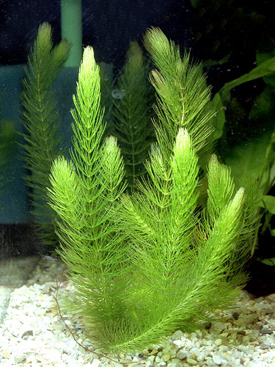
Hornwort
Ceratophyllum demersum
Wild range: cosmopolitan (North America)
At a glance: Hornwort care
Compiled reference information. Review the care notes and original sources below.
What temperature is listed for Hornwort?
The compiled profile lists 15.0–30.0 °C for Hornwort (Ceratophyllum demersum). Check the original sources below for context and differing recommendations.
What tank size is listed for Hornwort?
The profile lists a minimum tank volume of 5.0 US gallons (20.0 liters). Volume alone does not establish suitability; consider dimensions, group size and other inhabitants alongside the full care notes.
What pH is listed for Hornwort?
The compiled profile lists a pH of 6.0–8.0. Review the cited care sources alongside the other water parameters in this profile.
Natural habitat
Ceratophyllum demersum, commonly known as hornwort, thrives in a variety of freshwater habitats, including lakes, ponds, and quiet streams. It prefers warm summer water temperatures ranging from 15°C to 30°C. The plant is adaptable to various substrates, including sand, loam, and clay, making it suitable for different tank setups.
Where they are found
Commonly found in North America and other regions, Hornwort is adaptable and can grow in a wide range of water conditions.
Aquarium care
Hornwort is a hardy plant that does not require soil for growth, making it ideal for aquariums and ponds. It should be placed submerged, ideally about 15-25 cm below the water's surface. This plant benefits from moderate lighting, but prolonged exposure to strong light should be avoided to prevent potential issues with algae.
Feeding
As a detritivore, hornwort benefits from nutrient-rich conditions. It can absorb nutrients directly from the water, making it a good companion for fish that produce waste, helping to keep the aquarium's ecosystem balanced.
Compatibility
Hornwort is generally compatible with a wide variety of fish species. It provides shelter and hiding spaces, making it suitable for breeding environments while also reducing stress for aquatic inhabitants.
Breeding
Propagation can be achieved by cutting the stems and replanting them. Ensure that any cuttings have sufficient light and water conditions to thrive.
Sources
Compiled from multiple independent care sheets — not copied from a single site.