fish · Botiidae
Golden zebra loach
Botia histrionica
Wild range: Myanmar (Ayeyarwady/Irrawaddy, Sittaung, Salween and Ataran drainages) and Manipur, India; Seriously Fish also records upper Ayeyarwady headwaters in Yunnan, China. Type locality 'Pegu, Tenasserim'. Western Thailand and Nepal are mentioned by some hobby sources but are unconfirmed. (Asia)

At a glance: Golden zebra loach care
Compiled reference information. Review the care notes and original sources below.
What temperature is listed for Golden zebra loach?
The compiled profile lists 22.0–28.0 °C for Golden zebra loach (Botia histrionica). Check the original sources below for context and differing recommendations.
What tank size is listed for Golden zebra loach?
The profile lists a minimum tank volume of 55.0 US gallons (208.0 liters). Volume alone does not establish suitability; consider dimensions, group size and other inhabitants alongside the full care notes.
What pH is listed for Golden zebra loach?
The compiled profile lists a pH of 6.5–7.5. Review the cited care sources alongside the other water parameters in this profile.
Natural habitat
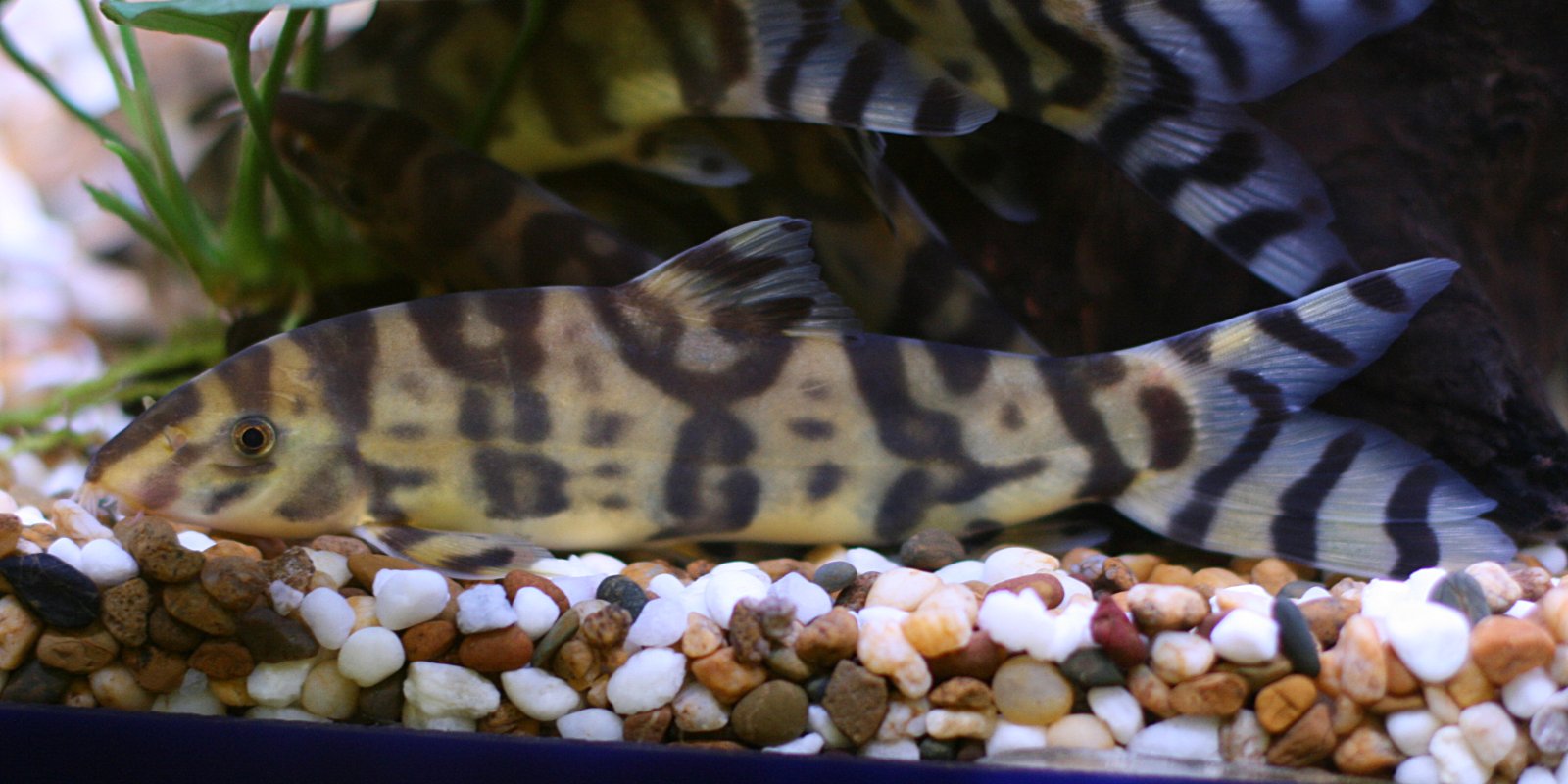
A medium-sized botiid loach with a stocky, golden-yellow body crossed by five broad dark bars (the central bar often Y-shaped in juveniles). Adults' patterns break up and the ground colour fades toward grey with age, and patterning varies by river population. Unusually active and visible by day for a Botia, it forages over sand and among rocks, uses an erectile spine under each eye in defence and dominance disputes, and lives in groups with a visible pecking order (including 'greying out' during fights).
Where they are found
Catalog primary Botia histrionica Blyth, 1860 — valid in ITIS (TSN 687807), FishBase (SpecCode 24691) / Catalog of Fishes, and GBIF (accepted); no newer rename in use. Trade names: Golden zebra loach, Gold zebra loach, Burmese loach, Burmese zebra loach (Seriously Fish; Tropical Fish Keeping; AquaInfo; Aqua Imports). Member of the B. histrionica group with B. kubotai (angelicus-botia in this catalog) and B. udomritthiruji (Grant 2007, per Seriously Fish); juveniles are often confused with B. kubotai, and adult patterning differs between Ayeyarwady, Salween, Manipur and Ataran populations, some of which may prove to be distinct species. Not the same fish as zebra-loach (Botia striata, India). Seriously Fish also reports hormone-produced hybrids, including a B. histrionica × Chromobotia macracanthus cross, appearing in the trade. Family Botiidae (GBIF backbone still files it under Cobitidae). IUCN Least Concern (assessed 2010-05-27; FishBase 2025-2).
Aquarium care
Plan at least a 55 US gallon (~208 L) tank with a 120 × 45 cm footprint for the recommended group: Seriously Fish gives a 120 × 45 cm base (~243 L), Tropical Fish Keeping 55 gal, Atlarium ≥180 L, Aqua Imports 40 gal+, and AquaInfo at least 1 m long (30 gal for a small group); larger groups need more. Temperature 22–28°C (Seriously Fish and Atlarium 22–28; AquaInfo 25–28; Tropical Fish Keeping 76–84°F; Aqua-Fish 25–29). pH 6.5–7.5 (AquaInfo, Atlarium and Aqua-Fish 6.5–7.5; Seriously Fish 6.0–7.5; Aqua Imports 6.8–7.5) and GH roughly 2–10 dGH (Seriously Fish 2–10; Atlarium 2–12; AquaInfo 5–10). Use soft sand or fine gravel to protect the barbels, plus smooth water-worn rocks, wood and caves; avoid sharp-edged décor and seal small gaps where loaches can get trapped. Provide a moderate current and high oxygenation, mature biological filtration, and weekly 30–50% water changes; they are intolerant of organic waste and prone to ich after temperature shocks. Keep a tight lid, as they jump. Intermediate difficulty: never add to an immature tank.
Feeding
Omnivore with a strong preference for meaty foods; the wild diet is aquatic snails, insect larvae, worms and other invertebrates (Seriously Fish; Atlarium). Offer quality sinking pellets and wafers, flakes, live or frozen bloodworm, brine shrimp, daphnia and blackworm, plus blanched vegetables such as cucumber, courgette or spinach (Seriously Fish; Tropical Fish Keeping; Aqua-Fish; AquaInfo). Avid snail eaters, and they may nibble soft-leaved plants. Bold feeders that often rise into midwater at mealtimes.
Compatibility
Peaceful toward other species and suited to a community of similar-sized, active fish such as danios, rasboras, medium barbs and other botiids (AquaInfo; Tropical Fish Keeping; Atlarium; Aqua-Fish). Gregarious: keep at least 5–6, ideally more, because singles, pairs or trios become withdrawn or bully each other (Seriously Fish; AquaInfo; Atlarium; Aqua Imports). Avoid much smaller or timid fish and slow, long-finned species such as fancy bettas and guppies, which may be nipped (Seriously Fish). Will eat snails and may harass very small shrimp. communitysafe true with those caveats; nanook false.
Breeding
No reliable home-aquarium breeding record; commercial production uses hormones (Seriously Fish; AquaInfo; Atlarium). Mature females are fuller-bodied with a rounder snout, while males have a longer snout and fleshier lips (Seriously Fish; Atlarium).
Sources
Compiled from multiple independent care sheets — not copied from a single site.