fish · Callichthyidae
Elegant corydoras
Corydoras elegans
Wild range: Western/upper Amazon River basin (type locality Amazon River at Tefé, Amazonas, Brazil; recorded from Peruvian Ríos Yavarí, Itaya, Nanay, Carahuayte, Tamaya, Ampiyacu, and Ucayali; Ecuadorian Ríos Aguarico and Napo; Brazilian rio Solimões) (South America)
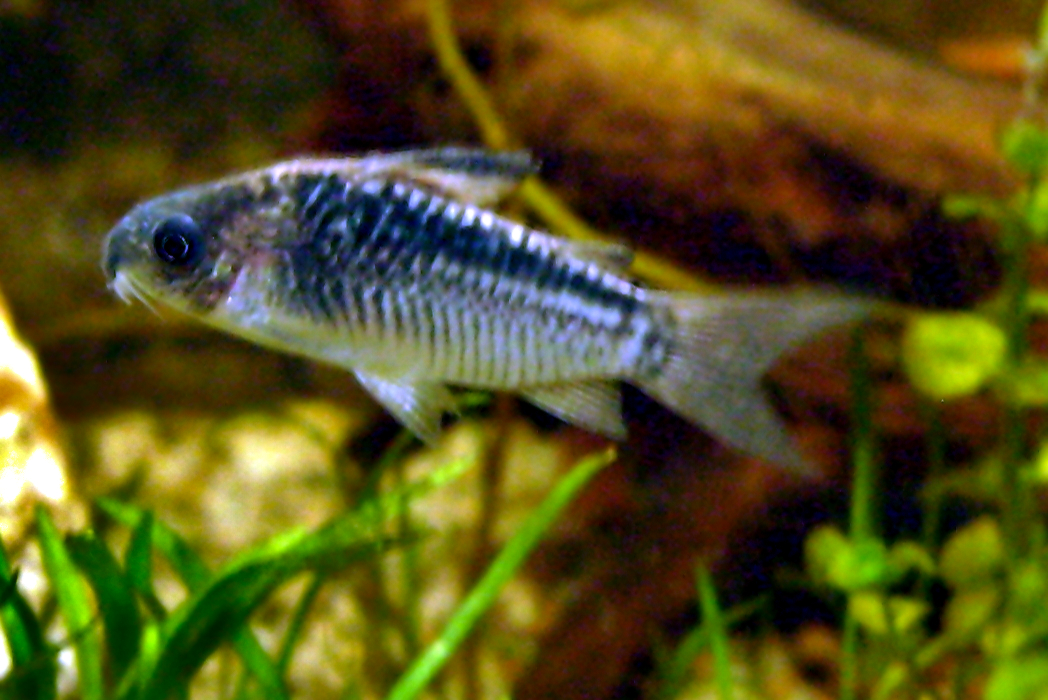

At a glance: Elegant corydoras care
Compiled reference information. Review the care notes and original sources below.
What temperature is listed for Elegant corydoras?
The compiled profile lists 22.0–26.0 °C for Elegant corydoras (Corydoras elegans). Check the original sources below for context and differing recommendations.
What tank size is listed for Elegant corydoras?
The profile lists a minimum tank volume of 20.0 US gallons (76.0 liters). Volume alone does not establish suitability; consider dimensions, group size and other inhabitants alongside the full care notes.
What pH is listed for Elegant corydoras?
The compiled profile lists a pH of 6.0–7.5. Review the cited care sources alongside the other water parameters in this profile.
Natural habitat
Small callichthyid armored catfish of the unofficial Corydoras elegans group. Unlike most bottom-sifting congeners it often schools in midwater as well as foraging over sand, mud, leaf litter, and fallen wood in forested Amazonian streams. Facultative air-breather. Popular peaceful community cory with a reticulated/striped elegant pattern; males usually more intensely marked than females.
Where they are found
Catalog primary locked as Corydoras elegans Steindachner, 1876 per inventory/trade lock and ITIS Current Standing valid (TSN 164299). Eschmeyer Catalog of Fishes Current status Valid as Gastrodermus elegans (Steindachner 1876) after Dias et al. 2024 (Zool. J. Linn. Soc.) Corydoradinae reclassification; FishBase and Planet Catfish/Seriously Fish profiles now head as Gastrodermus elegans — Gastrodermus elegans recorded in aliases and here as the newer CoF/FishBase/PC/SF combination, not adopted as primary (Scott naming rule 2026-09-24). Synonym Corydoras pestai Holly, 1940 (and misspellings Cordoras/Corydorus elegans) also in aliases. Distribution: western Amazon basin — Brazil, Peru, Ecuador (Seriously Fish detailed drainages; FishBase Upper Amazon). Wikipedia/Atlarium also mention Colombia — not added to native_countries (SF primary list).
Aquarium care
Peaceful midwater-leaning schooling cory for a cycled freshwater community. Locked minimum 20 US gallons (~76 L) for a group of six (Aquarium Co-Op general non-dwarf Corydoras >=20 gal; Atlarium >=75 L; Aqueon prefers ~30 gal for most Corydoras — 20 gal footprint-first OK for a dedicated school). Soft-to-medium water ~22–26°C, pH ~6.0–7.5, GH ~2–15 dGH (FishBase 22–26°C / pH 6.0–8.0 / dH 2–25; Seriously Fish 20–26°C / pH 6.0–7.5 / 1–15 dGH; Planet Catfish 22–25°C / pH 6.0–7.4; Aquaticcommunity breeding band 22–26°C / ~pH 6.5 / dH 2–25; Atlarium 22–26°C / pH 6–7.5 / GH 2–15 — locked core overlap 22–26°C, 6.0–7.5, 2–15 with SF lower-to-20°C, PC upper-to-25°C, and FishBase/Aquaticcommunity hardness upper to 25 dGH / pH to 8.0 noted). Fine sand preferred (SF/PC); smooth rounded gravel acceptable if kept clean — avoid sharp gravel that damages barbels. Provide open midwater swimming lanes among plants plus driftwood/leaf litter shade (PC: mid-water species needing shady open space). Gentle flow with good oxygenation (facultative air-breather); increase flow/aeration when triggering spawns. Beginner-friendly when water quality and group size are respected.
Feeding
Foraging omnivore — do not rely on leftover scraps or algae alone (Seriously Fish, Planet Catfish, Aquarium Co-Op). Offer sinking wafers/tablets/granules plus regular live or frozen bloodworm, Tubifex, Daphnia, brine shrimp, grindal/white worm. Because this species often feeds in the water column as well as on the bottom, ensure midwater and sinking foods both reach the school.
Compatibility
Peaceful community fish when kept in a shoal of at least six (Seriously Fish 4–6; Aquaticcommunity/Atlarium/ACO prefer 6+). Excellent with similarly peaceful tetras, rasboras, small barbs, and soft-water dwarf cichlids. Avoid large predatory tankmates and aggressive diggers. Distinct midwater habit versus typical bottom-only Corydoras — pairs well in planted South American layouts. Not a nano species at locked 20 gal school size.
Breeding
Seriously Fish: ratio ~2 males per female; large (50–70%) cooler water changes with increased oxygenation/flow until spawning; eggs on glass, fine-leaved plants, or mops; remove adults or eggs; methylene blue or alder cones help prevent fungus; hatch ~3–4 days; fry take microworm/Artemia after yolk absorption. Aquaticcommunity: eggs very small vs many Corydoras — start with liquid fry food. Planet Catfish: classic T-position clinch may be absent; 6 breeding reports on site. Soft acidic water and meaty conditioning improve success.
Sources
Compiled from multiple independent care sheets — not copied from a single site.