fish · Poeciliidae
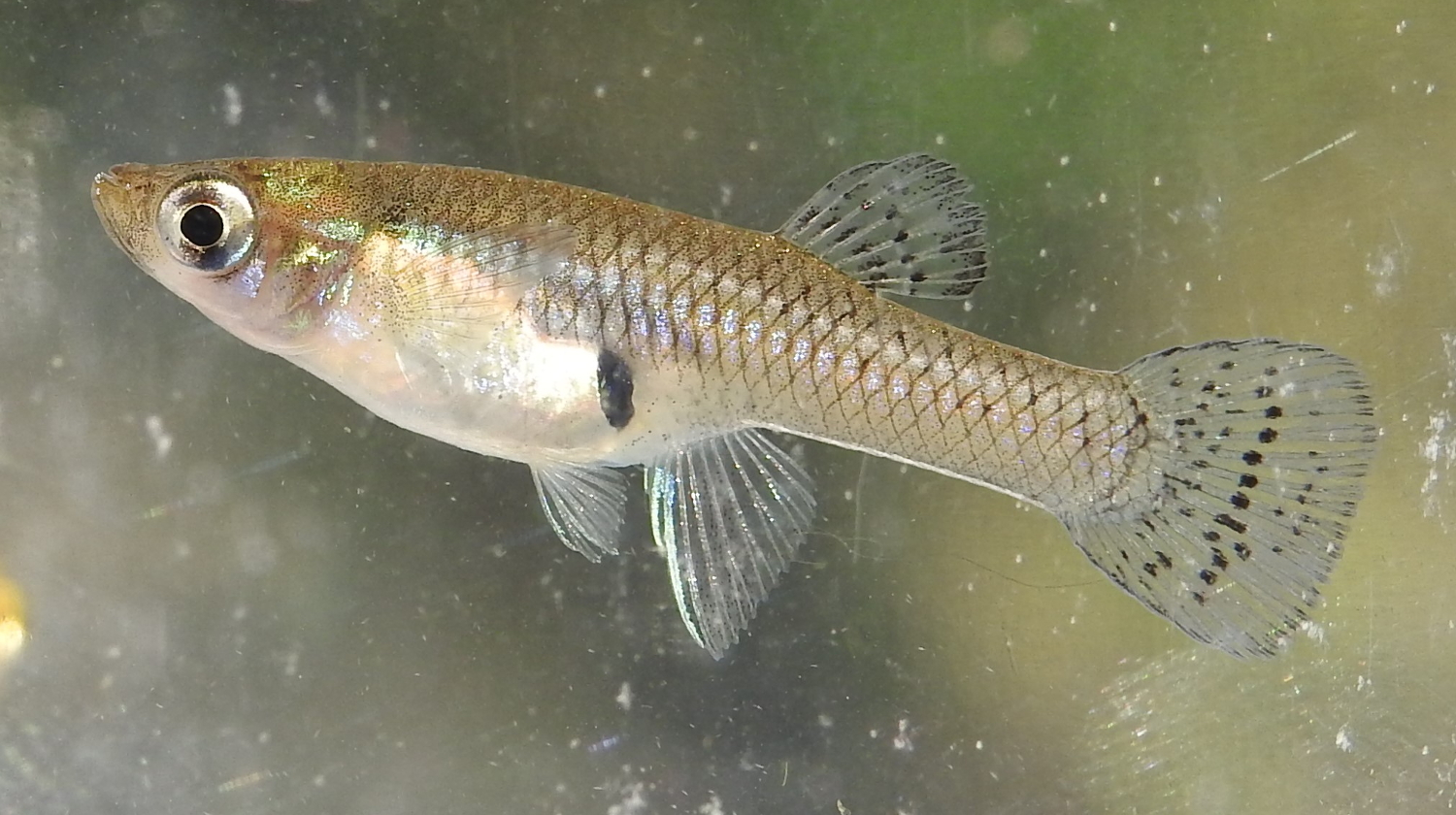
Eastern mosquitofish
Gambusia holbrooki
Wild range: Atlantic and Gulf Slope drainages of the eastern United States from New Jersey south to Alabama (type localities Palatka, eastern Florida, and Charleston, South Carolina); widely introduced worldwide for mosquito control (North America)

At a glance: Eastern mosquitofish care
Compiled reference information. Review the care notes and original sources below.
What temperature is listed for Eastern mosquitofish?
The compiled profile lists 15.0–35.0 °C for Eastern mosquitofish (Gambusia holbrooki). Check the original sources below for context and differing recommendations.
What tank size is listed for Eastern mosquitofish?
The profile lists a minimum tank volume of 10.0 US gallons (38.0 liters). Volume alone does not establish suitability; consider dimensions, group size and other inhabitants alongside the full care notes.
What pH is listed for Eastern mosquitofish?
The compiled profile lists a pH of 6.0–8.5. Review the cited care sources alongside the other water parameters in this profile.
Natural habitat
Standing to slow-flowing, heavily vegetated margins of ponds, lakes, backwaters, ditches, and quiet stream pools; often shoals at the surface edges and tolerates brackish water (FishBase, UF/IFAS, Aquarist Atlas).
Where they are found
Catalog primary locked as Gambusia holbrooki Girard, 1859 — eastern mosquitofish — per inventory lock, US trade/extension usage (UF/IFAS FA202), FishBase SpecCode 4521 (accepted), and Eschmeyer’s Catalog of Fishes Current status Valid as Gambusia holbrooki Girard 1859 (CoF spid 14160; Poeciliidae: Poeciliinae; lectotype ANSP 6976 selected by Huber 2019; type locality Palatka, eastern Florida / Charleston, South Carolina). Distinct sister species from catalog mosquitofish (*Gambusia affinis* (Baird & Girard, 1853) — western); modern literature and Seriously Fish separate them by gonopodium serration (holbrooki leading ray serrated) and dorsal-ray count (holbrooki usually 7 vs affinis usually 6). ITIS TSN 165896 still lists G. holbrooki as invalid junior synonym of G. affinis (stale vs 2004 Catalog of Fishes) — noted only; do not merge rows. Historical subspecies usage Gambusia affinis holbrooki / spelling holbrookii and Agassiz manuscript Heterandria holbrookii retained in aliases. IUCN Least Concern (FishBase Ref. 130435 Version 2025-2; assessed 2012-02-06). Extremely widely introduced; invasive and harmful to native fishes/amphibians outside its range — never release outdoors; often confused with G. affinis in introduction records.
Aquarium care
Hardy eastern US livebearer kept for ponds, mosquito-larvae control programs, and species aquaria (UF/IFAS, FishBase, Aquadiction, Aquarist Atlas). Plan at least a 10 US gallon / ~38–40 L planted tank (Aquadiction 40 L floor; matches sibling western mosquitofish). Prefer gently filtered, heavily planted setups with floating cover and a secure lid (jumpers). Documented subtropical band 15–35°C, pH ~6.0–8.5 (FishBase 6.0–8.8; Aquadiction 6.0–8.5), and GH roughly 5–25 practical (Aquadiction 5–15; FishBase hardness to ~40 dH — mid overlap with sibling catalog). UF/IFAS notes culture preference near 31–35°C for fastest growth/reproduction and extreme tolerance ~1–40°C (Pyke 2008) — aquarium lock keeps the multi-host FishBase/Aquadiction/Atlas band. Not a community fish: fin-nipper that harasses smaller/long-finned tankmates and eats fry and small invertebrates. Best species-only, robust short-finned companions, or outdoor pond stock where legal and native. Never release into natural waters outside the native eastern US range.
Feeding
Opportunistic micro-predator/omnivore: quality flakes or micro-pellets as staple plus frequent live/frozen Daphnia, brine shrimp, bloodworms, and other small invertebrates; wild diet includes small terrestrial insects in surface drift, mosquito larvae, crustaceans, and some plant/algae/detritus (FishBase, UF/IFAS, Aquadiction). Feed small portions; avoid overfeeding in small tanks.
Compatibility
Poor community choice. Notorious fin-nipper and bully of smaller or long-finned fish; will eat eggs, fry, dwarf shrimp, and other tiny tankmates (Aquadiction, Aquarist Atlas; behavior mirrors SF notes on sister G. affinis). Keep species-only, or only with robust similarly assertive short-finned fish — and expect male harassment. Distinct from catalog mosquitofish (*G. affinis*); do not merge. Never release outdoors outside the native eastern US range (UF/IFAS; invasive worldwide).
Breeding
Prolific livebearer. Males smaller with a gonopodium; females larger (to ~8 cm) with a gravid spot. Gestation roughly 3–4 weeks (Aquadiction ~22–25 days); typical broods ~40–60, exceptionally to ~350 (FishBase, UF/IFAS, Aquarist Atlas). Matures in ~4–6 weeks; up to ~3 generations per year in warm conditions. Adults readily eat fry — use dense plants, a fry refuge basket, or a separate raising tank (UF/IFAS tank-culture notes). Prefer female-biased groups to reduce male harassment (Aquadiction, UF/IFAS).
Sources
Compiled from multiple independent care sheets — not copied from a single site.