Catalog / fish / Dwarf spotted rasbora
fish · Cyprinidae
Dwarf spotted rasbora
Boraras maculatus
Wild range: Southeast Asia (Asia)
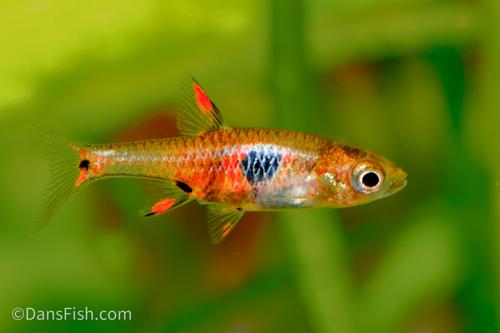
At a glance: Dwarf spotted rasbora care
Compiled reference information. Review the care notes and original sources below.
What temperature is listed for Dwarf spotted rasbora?
The compiled profile lists 22.0–27.0 °C for Dwarf spotted rasbora (Boraras maculatus). Check the original sources below for context and differing recommendations.
What tank size is listed for Dwarf spotted rasbora?
The profile lists a minimum tank volume of 7.9 US gallons (30.0 liters). Volume alone does not establish suitability; consider dimensions, group size and other inhabitants alongside the full care notes.
What pH is listed for Dwarf spotted rasbora?
The compiled profile lists a pH of 4.5–8.3. Review the cited care sources alongside the other water parameters in this profile.
Natural habitat
Dwarf Rasboras are typically found in slow-moving streams and flooded areas with plenty of vegetation. The waters are slightly acidic to neutral, with soft to moderately hard water, providing the ideal conditions for these small fish to thrive.
Where they are found
This species is native to Thailand and Myanmar, where it inhabits still or slow-moving waters, usually found in dense vegetation.
Aquarium care
In the aquarium, Dwarf Rasboras thrive best in planted tanks with stable temperature and water conditions. They require a minimum tank size of 37.8541 liters (10 gallons), but larger tanks of 56.7816 to 75.7082 liters (15-20 gallons) are recommended to provide ample swimming space for schools of 8-10 or more. Regular water changes and proper filtration are essential to maintain their health.
Feeding
Dwarf Rasboras are omnivorous, thriving on a varied diet that includes high-quality flake foods, micro-pellets, and live or frozen foods such as daphnia and brine shrimp. They have a small mouth, so smaller food particles are best for them.
Compatibility
These fish are peaceful and should be kept with other small, gentle fish such as ember tetras, small Corydoras species, dwarf shrimp, and various small rainbowfish. Avoid housing them with larger fish that may see them as prey.
Breeding
Breeding these rasboras is relatively straightforward if conditions are suitable. Providing fine-leaved plants will help them lay their eggs, and soft, acidic water may promote spawning.
Sources
Compiled from multiple independent care sheets — not copied from a single site.