Catalog / fish / Dwarf gourami
fish · Osphronemidae
Dwarf gourami
Trichogaster lalius
Wild range: Indian subcontinent (Asia)
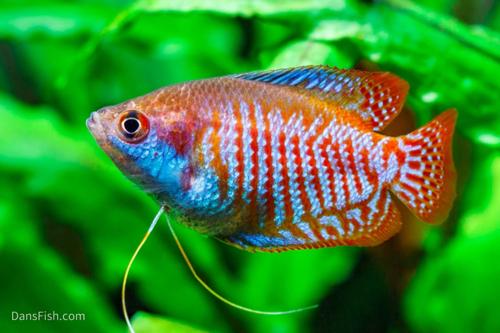
At a glance: Dwarf gourami care
Compiled reference information. Review the care notes and original sources below.
What temperature is listed for Dwarf gourami?
The compiled profile lists 22.0–28.0 °C for Dwarf gourami (Trichogaster lalius). Check the original sources below for context and differing recommendations.
What tank size is listed for Dwarf gourami?
The profile lists a minimum tank volume of 5.0 US gallons (19.0 liters). Volume alone does not establish suitability; consider dimensions, group size and other inhabitants alongside the full care notes.
What pH is listed for Dwarf gourami?
The compiled profile lists a pH of 6.0–8.0. Review the cited care sources alongside the other water parameters in this profile.
Natural habitat
Dwarf Gourami inhabit slow-moving, shallow waters rich in vegetation typical of rice fields, swamps, and ponds, primarily in the Indian subcontinent. These environments provide ample cover and surface access for air-breathing through their labyrinth organ.
Where they are found
These fish are widely distributed across Pakistan, northern India, and Bangladesh. They are often bred in captivity, decreasing the likelihood of encountering wild specimens in the aquarium trade.
Aquarium care
For optimal care, maintain a planted aquarium with plenty of floating plants to mimic their natural habitat. The tank should be well-cycled, with gentle filtration to prevent stress to these sensitive fish. Regular water changes and monitoring water parameters are essential for their health.
Feeding
In captivity, Dwarf Gourami require a varied diet of high-quality flake/pellet foods, supplemented with live or frozen foods such as bloodworms and brine shrimp for optimal health and coloration.
Compatibility
These fish are generally peaceful and do well in community setups. They should be housed with other non-aggressive species that match their temperament. Care should be taken to avoid housing multiple males together to prevent territorial disputes.
Breeding
Breeding this species requires a separate spawning tank with adequate cover and suitable plants for nesting. The male builds a bubble nest, and spawning can be initiated when the female is prepared with eggs.
Sources
Compiled from multiple independent care sheets — not copied from a single site.