Catalog / fish / Clown killifish
fish · Nothobranchiidae
Clown killifish
Epiplatys annulatus
Wild range: West Africa (Africa)
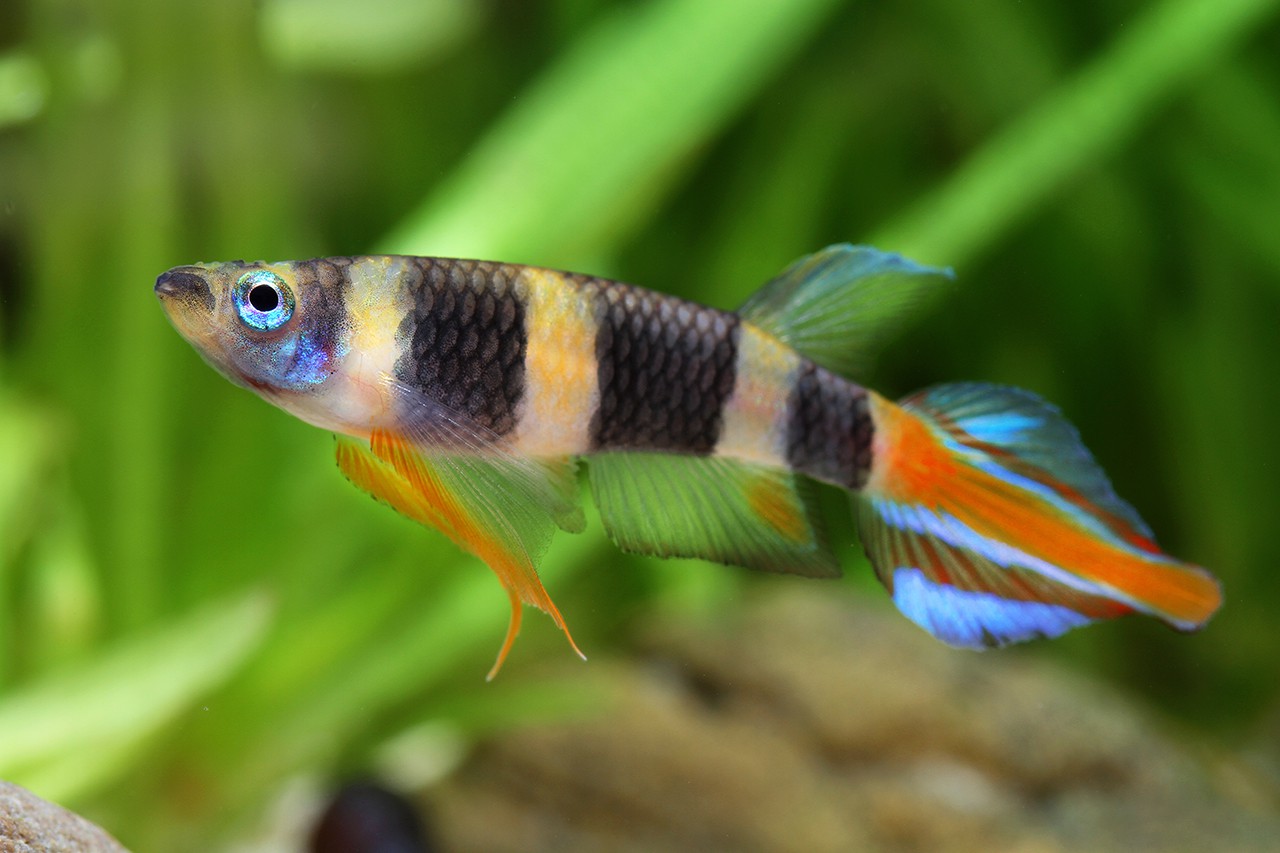
At a glance: Clown killifish care
Compiled reference information. Review the care notes and original sources below.
What temperature is listed for Clown killifish?
The compiled profile lists 19.4–26.7 °C for Clown killifish (Epiplatys annulatus). Check the original sources below for context and differing recommendations.
What tank size is listed for Clown killifish?
The profile lists a minimum tank volume of 5.0 US gallons (18.9 liters). Volume alone does not establish suitability; consider dimensions, group size and other inhabitants alongside the full care notes.
What pH is listed for Clown killifish?
The compiled profile lists a pH of 4.0–7.0. Review the cited care sources alongside the other water parameters in this profile.
Natural habitat
Clown killifish inhabit soft, acidic blackwater environments often rich in leaf litter and forest debris. These habitats are typically found in areas with slow-moving waters, such as forest streams and swamps, where they can be quite skittish.
Where they are found
This species is primarily found in its native habitat of Sierra Leone, Guinea, and Liberia, where they inhabit slow-moving or still waters that are rich in vegetation.
Aquarium care
To successfully maintain clown killifish, replicate their natural habitat by providing a heavily planted aquarium with floating plants, gentle water flow, and sufficient cover. Mature tanks are preferred to avoid drastic changes that can stress the fish.
Feeding
Clown killifish thrive on a diet rich in live foods such as baby brine shrimp, frozen food, and flakes. Picky eaters in captivity, their health significantly improves with a live food diet.
Compatibility
Clown killifish are timid and should be housed with similarly peaceful species such as Panda Cories and Microrasboras. They can coexist with shrimp and snails, but care should be taken with smaller shrimp due to potential predation.
Breeding
Breeding clown killifish is straightforward under the right conditions. Maintaining a sex ratio of one male to two or three females enhances the chances of successful spawning. Floating plants are ideal for egg deposition, with hatching occurring in 9 to 12 days.
Sources
Compiled from multiple independent care sheets — not copied from a single site.