Catalog / fish / Round-tailed paradise fish
fish · Osphronemidae
Round-tailed paradise fish
Macropodus ocellatus
Wild range: Northeast Asia (Asia)
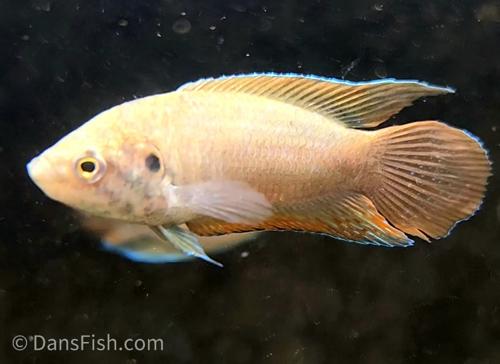
At a glance: Round-tailed paradise fish care
Compiled reference information. Review the care notes and original sources below.
What temperature is listed for Round-tailed paradise fish?
The compiled profile lists 10.0–27.0 °C for Round-tailed paradise fish (Macropodus ocellatus). Check the original sources below for context and differing recommendations.
What tank size is listed for Round-tailed paradise fish?
The profile lists a minimum tank volume of 30.0 US gallons (113.6 liters). Volume alone does not establish suitability; consider dimensions, group size and other inhabitants alongside the full care notes.
What pH is listed for Round-tailed paradise fish?
The compiled profile lists a pH of 6.0–7.8. Review the cited care sources alongside the other water parameters in this profile.
Natural habitat
The Round Tailed Paradise Fish inhabit irrigation ditches, marshes, rice paddies, pools, streams, and the slow-moving backwaters of larger rivers. They are found in regions where winter temperatures can drop significantly, causing their habitats to freeze over. Despite this, they are adapted to thrive in colder wetlands with dense vegetation.
Where they are found
This species is native to freshwater habitats in parts of Brazil, Colombia, and Venezuela, where they thrive in both still and flowing waters often near submerged structures.
Aquarium care
A densely planted aquarium of at least 30 gallons is ideal, with a substrate of fine gravel along with some rocks and driftwood for hiding spots. The water temperature should range between 10 to 22°C, closely mimicking their natural habitat.
Feeding
Feed your common pleco a balanced diet comprising high-quality algae wafers, fresh vegetables like zucchini and cucumber, and protein-rich foods such as bloodworms or shrimp. It's important to feed them at night when they are most active.
Compatibility
They coexist peacefully with many community fish, but caution should be taken with smaller species that might fit in their mouths or aggressive fish that could disturb them.
Breeding
They are bubble nest builders, similar to Macropodus opercularis. Males will construct a bubble nest, after which mating occurs beneath it. Soft water with slightly elevated temperatures can trigger breeding behavior.
Sources
Compiled from multiple independent care sheets — not copied from a single site.