Catalog / fish / Barred bichir
fish · Polypteridae
Barred bichir
Polypterus delhezi
Wild range: Congo River Basin (Africa)
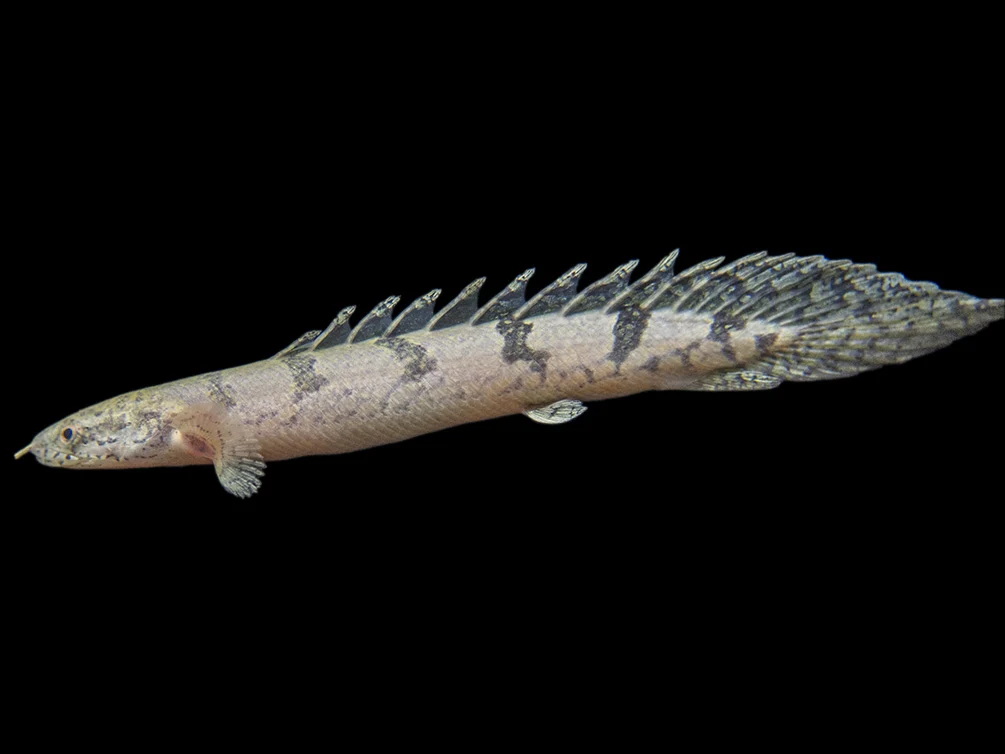
At a glance: Barred bichir care
Compiled reference information. Review the care notes and original sources below.
What temperature is listed for Barred bichir?
The compiled profile lists 24.0–28.0 °C for Barred bichir (Polypterus delhezi). Check the original sources below for context and differing recommendations.
What tank size is listed for Barred bichir?
The profile lists a minimum tank volume of 79.0 US gallons (300.0 liters). Volume alone does not establish suitability; consider dimensions, group size and other inhabitants alongside the full care notes.
What pH is listed for Barred bichir?
The compiled profile lists a pH of 6.0–8.0. Review the cited care sources alongside the other water parameters in this profile.
Natural habitat
Polypterus delhezi is predominantly found in the Congo River Basin, preferring slow-moving waters with plenty of cover such as rocks and vegetation. They are primarily nocturnal and thrive in dimly lit environments.
Where they are found
The distribution of bichirs showcases their adaptability to various habitat conditions, ranging from aquatic ecosystems adjacent to lakes to dense swamp areas. Fossils indicate they existed well before the divisions of modern continents.
Aquarium care
Provide a spacious aquarium of at least 300 liters with strong biological and mechanical filtration due to their waste production. A secure lid is essential as they are known jumpers. Include hiding spots such as caves and driftwood to offer territorial boundaries.
Feeding
Feed bichirs a diet that primarily consists of pellets, supplemented with frozen or live food such as bloodworms, brine shrimp, and small fish. Moderation is key to prevent obesity, as they have a tendency to overeat.
Compatibility
Bichirs are generally peaceful and can coexist with other large non-aggressive fish. However, caution should be exercised with smaller fish, as bichirs are opportunistic feeders and may attempt to eat them.
Breeding
Breeding in captivity can be challenging. Like many fish, they are egg layers, and creating suitable conditions may require mimicking their natural habitat with calm waters and appropriate cover.
Sources
Compiled from multiple independent care sheets — not copied from a single site.