plant · Plantaginaceae
Moneywort
Bacopa monnieri
Wild range: sub-tropical (Asia)
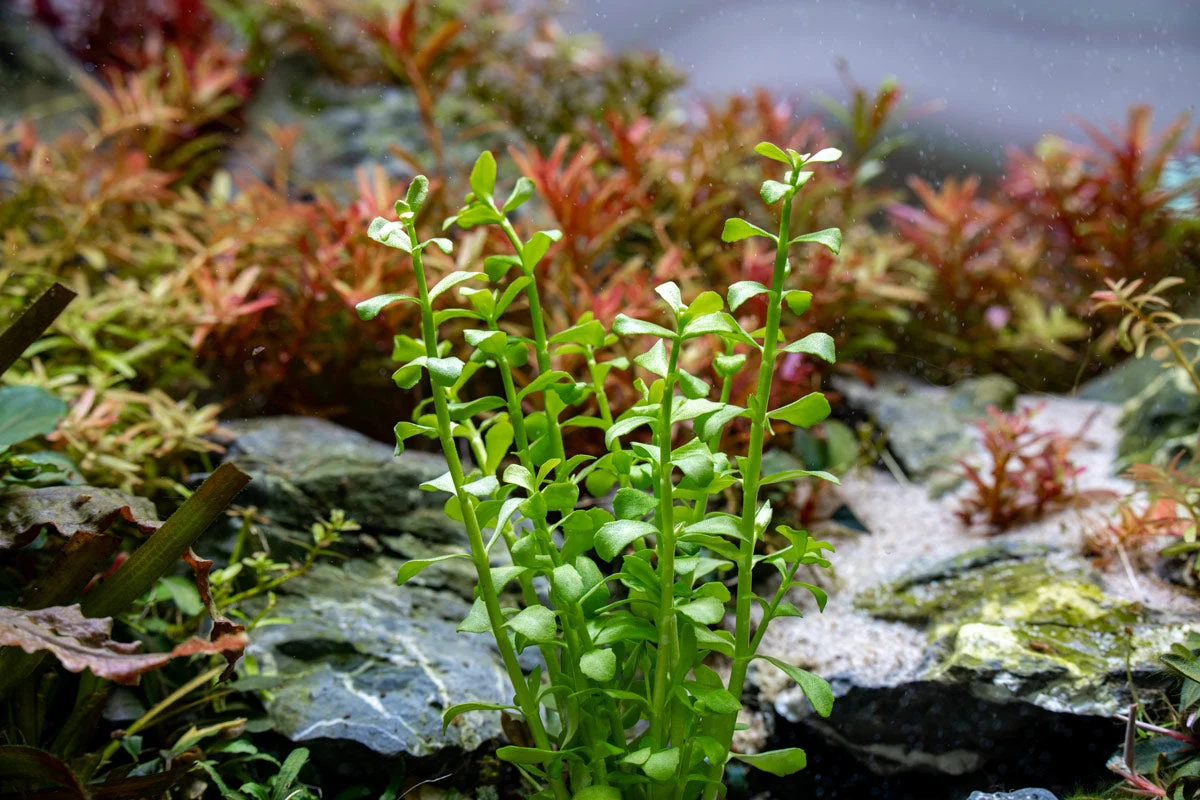
At a glance: Moneywort care
Compiled reference information. Review the care notes and original sources below.
What temperature is listed for Moneywort?
The compiled profile lists 18.0–28.0 °C for Moneywort (Bacopa monnieri). Check the original sources below for context and differing recommendations.
What tank size is listed for Moneywort?
The profile lists a minimum tank volume of 2.6 US gallons (10.0 liters). Volume alone does not establish suitability; consider dimensions, group size and other inhabitants alongside the full care notes.
What pH is listed for Moneywort?
The compiled profile lists a pH of 5.5–8.5. Review the cited care sources alongside the other water parameters in this profile.
Natural habitat
Bacopa monnieri, or Moneywort, is commonly found in shallow waters and wetlands of subtropical regions, thriving in a variety of aquatic conditions. It is often seen in slow-moving water bodies where it's able to secure itself in the substrate.
Where they are found
This species is widely distributed in North America and can often be found growing along the banks of slow-moving rivers and ponds.
Aquarium care
In aquariums, Bacopa monnieri requires moderate to high lighting for optimal growth and to prevent lower leaf rot. It benefits from regular pruning to promote bushier growth and better light penetration within densely planted setups.
Feeding
As a rooted plant, Moneywort absorbs nutrients directly from the substrate and water, benefiting from fertilization especially in densely planted aquariums. Regular water changes and substrate maintenance will promote optimal growth.
Compatibility
Bacopa monnieri is safe to keep with a variety of community fish, as it does not pose any threats due to its peaceful nature. Ensure that tank mates do not uproot or damage the plant during their activities.
Breeding
Propagation is easily achieved by trimming stems and replanting the cuttings, which can develop roots quickly and form new clusters within the aquarium.
Sources
Compiled from multiple independent care sheets — not copied from a single site.