Catalog / fish / Freshwater angelfish
fish · Cichlidae
Freshwater angelfish
Pterophyllum scalare
Wild range: Amazon and Orinoco river basins (South America)
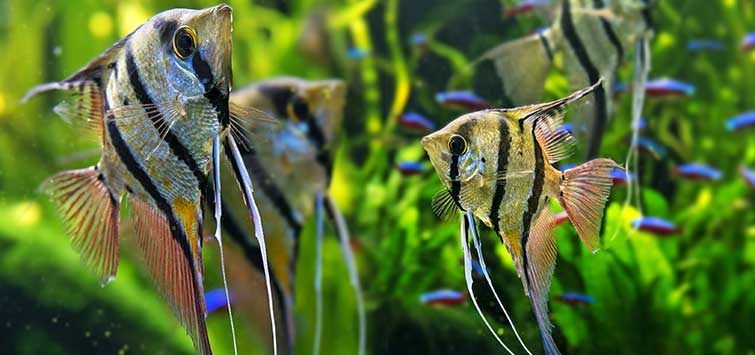
At a glance: Freshwater angelfish care
Compiled reference information. Review the care notes and original sources below.
What temperature is listed for Freshwater angelfish?
The compiled profile lists 25.0–28.9 °C for Freshwater angelfish (Pterophyllum scalare). Check the original sources below for context and differing recommendations.
What tank size is listed for Freshwater angelfish?
The profile lists a minimum tank volume of 7.5 US gallons (30.0 liters). Volume alone does not establish suitability; consider dimensions, group size and other inhabitants alongside the full care notes.
What pH is listed for Freshwater angelfish?
The compiled profile lists a pH of 6.2–7.8. Review the cited care sources alongside the other water parameters in this profile.
Natural habitat
Angelfish inhabit slow-moving waters, typically found among submerged vegetation in the vast river systems of South America. They prefer areas with plentiful hiding spots provided by plant life and driftwood, crucial for their ambush predation behavior.
Where they are found
They inhabit the tropical regions of South America, particularly in countries like Brazil, Peru, Colombia, and Venezuela.
Aquarium care
Provide a well-planted aquarium with plenty of vertical space and driftwood to mimic their natural habitat. Use a fine substrate and maintain stable water parameters, ideally with slight acidity and soft hardness. Regular partial water changes will help maintain water quality and support their health.
Feeding
As omnivores, angelfish thrive on a varied diet that includes tropical flakes, granules, and occasional live or frozen foods such as worms and crustaceans. It is important to offer food in small amounts that they can consume within a few minutes, once or twice daily.
Compatibility
While generally peaceful, angelfish can be semi-aggressive towards other angelfish, especially when spawning. They are best kept with larger tetras, rasboras, and other community fish like gouramis and corydoras, avoiding smaller species that might be seen as food.
Breeding
Angelfish breed readily in aquariums if raised in groups. Once paired, a female cleans a spawning surface, after which they guard their eggs diligently. It’s common for pairs to eat their own eggs, so separating them into a bare rearing tank can improve survival rates of the fry.
Sources
Compiled from multiple independent care sheets — not copied from a single site.